Is Rhodium the best horse in the stable?
In March 2020, we wrote an article about precious metals and how not all that glitters is gold. At the time of writing, the COVID-19 pandemic had just begun, and stock markets were plummeting worldwide. This is traditionally the time when gold literally “shines,” because it is seen as a safe haven.
How different does the world look now, almost a year later? The COVID-19 pandemic is still in full swing worldwide. Midway through last year, serious prospects for a developed vaccine were announced, and that vaccine is now actually being administered to large segments of the population. This has also sparked a major recovery in the stock market and, consequently, a decline in the price of gold. After all, people are selling their beloved gold bars and returning to the stock market, hoping to benefit from the prospect of economic recovery. It’s no coincidence that *De Volkskrant* noted in an article featuring Simone Huis in ’t Veld of Euronext Amsterdam that many retail investors have entered the stock market. While they initially accounted for just 5% of stock market trading, that figure rose to 8% last year.
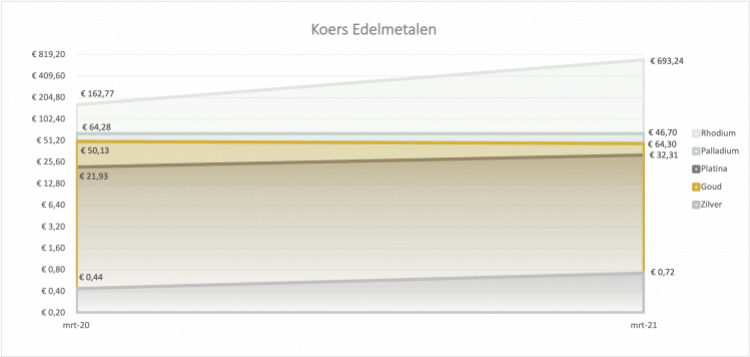
In our chart from last year, gold was trading at over €50 per gram. At the time of writing, the price is €46.50 per gram. This represents a decline of more than 7%. How different the picture is for the jewel of the dance floor, rhodium. In March 2020, we reported a price of €162.77 per gram. At that time, rhodium was already worth more than three times as much as gold. As of this writing, the price is €693 per gram—an unprecedented increase of 676%. Platinum has also seen a significant increase. In March 2020, the price was €21.92 per gram, and we’re currently quoting €32.40 per gram, an increase of over 30%. Only palladium has remained steady at around €64 per gram, which is still historically unprecedented.
Is the price increase—of rhodium in particular—the result of speculation, or is there more to it? The COVID-19 crisis seems to have pushed it to the back burner, but we’re also still in the midst of a climate crisis. This means that climate targets must be met by all parties that have signed the Paris Agreement. In that agreement, 195 countries, including the Netherlands, have committed to limiting the rise in the global average temperature to well below 2 degrees Celsius by 2050, and if possible, to 1.5 degrees Celsius. To achieve this, we’ll all have to reduce our emissions. This includes purchasing electric cars instead of vehicles powered by fossil fuels such as gasoline and diesel. Manufacturers of diesel- and gasoline-powered cars aren’t going to let themselves be pushed out of the market so easily and are developing technologies to burn these fuels more cleanly usingcatalytic converters. These catalytic converters contain precious metals such as platinum, palladium, and—yes—rhodium. Although global car sales have declined due to the COVID-19 pandemic and more and more electric vehicles are being purchased, automakers still seem to be heavily investing in this technology. China is once again proving to be an absolute game-changer. In October 2020, President Xi Jing Ping announced that China aims to be climate-neutral by 2060. Car sales in China are still growing, and a lot of European cars are being exported there—equipped with catalytic converters that, under the new Chinese policy, must also burn cleaner and therefore contain more precious metals.
This fact, combined with the fact that production in South Africa—the world’s largest producer of rhodium—was halted for quite some time due to the COVID-19 pandemic, has led to massive production shortfalls, causing prices to rise sharply. Although the mines have resumed operations, the backlog cannot be made up overnight, and significant shortages are still expected in 2021, which means further price increases cannot be ruled out.
The situation described above once again highlights the importance of recycling. Old catalytic converters from end-of-life vehicles can be easily recycled and reused in the production of new catalytic converters. Krommenhoek Metals in Rotterdam operates a fully equipped facility where the catalytic converters are cut, ground, and blended in the ratios required by refiners to recover platinum, palladium, and rhodium.
Need help?
Do you have any questions, or would you like immediate assistance? Our team is ready to provide you with personalized advice and the right solution.