Impact of Cheap Russian Steel on the Market
There is currently a rumor circulating that the recent drop in the price of scrap iron is caused by the dumping of Russian iron. This is reportedly being sold to Turkish steel mills at very low prices.
But figures on Russian export-bound steel shipped abroad by rail tell a different story. In May, this increased only marginally compared to the same period a year earlier. From this, we can infer that any influx of cheap Russian steel into the Turkish steel market had a limited impact—even though it was the “talk of the town.”
Now, the export data on Russian steel transported by rail is not 100% representative of total steel exports. But it is certainly a good indicator.
Steel shipments from Russia to Turkey have indeed increased. Compared to the same period last year, we see a 16% increase, bringing the total to 50,386 metric tons. However, that absolute figure is very low compared to the amounts of iron ore that Turkish steel mills normally require.
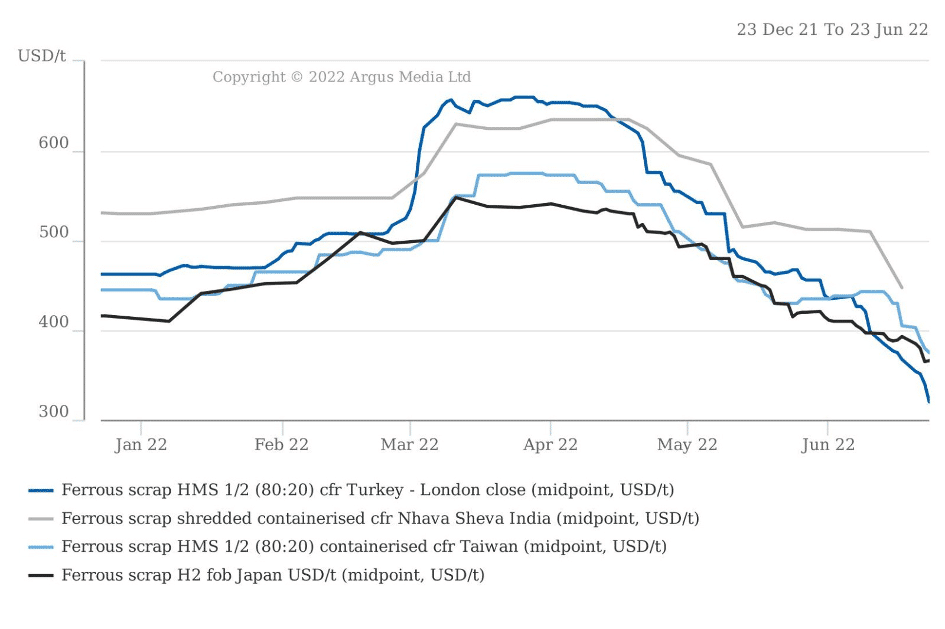
Price Chart: Scrap Prices for Bulk Deliveries to Mills (Source: Argus Media Group)
All of this actually confirms that there is no longer a significant amount of Russian steel being dumped on the Turkish market. It seems, above all, that Turkey simply has a lower demand for scrap metal to keep its factories running. That is the main reason for the falling scrap metal prices.
A very recent development in the market is that scrap exporters from all over the world are falling over themselves to offer large bulk shipments of iron scrap to Asia. Prices havefallenin the rest of Asia. For ocean freight, rates have already dropped by 40%: from approximately 100 USD per metric ton to 60 USD per metric ton.
Prices have also fallen in Asia, but much less sharply than in Turkey. Between May 1 and June 10, the price of iron in Turkey fell by 156.50 USD per metric ton. And from June 10 through the time of writing, it fell by another 21.50 USD. Pakistan saw a decline of 80 USD over that same period.
Until recently, selling bulk cargo from Europe/the UK to countries such as Pakistan was unthinkable. However, the decline in transportation costs has led to significant growth in shipments to Asia. Bulk cargo has also been sold to Bangladesh and Vietnam.
The distance to Asia is, of course, still enormous. That is why it is uncertain whether this continent can remain a buyer of European materials in the long term. Another increase in bulk freight rates could quickly throw a wrench in the works again. But at least all the materials currently heading to Asia are off the market. The expensive inventories, which have grown significantly, are thus being gradually reduced. In the somewhat longer term, this could contribute to a shortage.
Need help?
Do you have any questions, or would you like immediate assistance? Our team is ready to provide you with personalized advice and the right solution.