Vulnerable individuals dismantle e-waste for Krommenhoek Metals
To dismantle electronic waste, the scrap metal dealer Krommenhoek Metals regularly hires people who face barriers to entering the job market. This is not only a social consideration but also a business one. “I can take customers here with a clear conscience.”
“Building trust and appreciation—that’s what it’s all about”
Computers, server racks, and other electronic scrap… Basically, anything with a plug—except for monitors and refrigerators—is taken apart and dismantled in the disassembly hall ofStichting Samen Werkenin Bergen op Zoom. The hall is set up in accordance with RIVM guidelines, so that everyone can maintain a distance of 1.5 meters. Everywhere you look, there are large bins and bags filled with electric motors, circuit boards, iron, plastic, wiring, and other materials. It’s important to separate as many different components as possible during the dismantling process: the more thorough the dismantling, the greater the contribution to the circular economy.
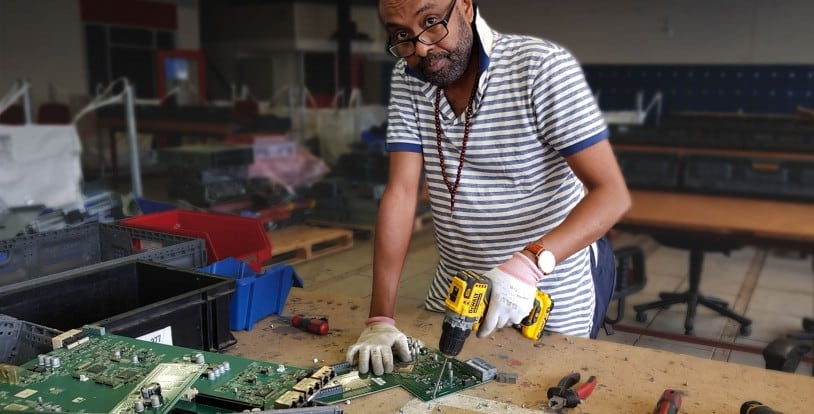
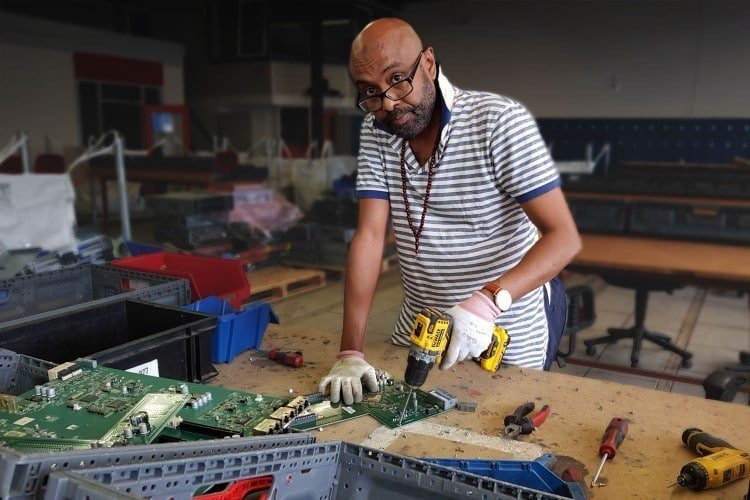
Baschir Hassan Ramadaan, a Somali national, is happy with the work he does at the foundation for Krommenhoek Metals. In his home country, he laid floors, but in the five years he’s been in the Netherlands, he found it difficult—if not impossible—to find work here. Now he dismantles e-waste four days a week. “They’ve really helped me here. I find this work varied—I even enjoy it more than my original job,” he laughs, as he uses a power drill to take apart a computer case.
Krommenhoek Metals delivers a shipment of electronic waste to the foundation about once a week, where some 20 clients work in the disassembly department. “As soon as we get a call that another shipment has been dismantled, we pick it up so we can reuse a small portion of it, and the rest is prepared for recycling by our computer and electronics recycling department,” says Robert Schlömer, account manager at Krommenhoek Metals in Rotterdam, which primarily collects scrap iron and other scrap metals.
Promoting Self-Reliance
Samen Werken focuses on vulnerable target groups: people who are traumatized and discouraged and who are not (yet) functioning in the mainstream workforce. This includes refugees, formerly homeless individuals, people with a history of addiction, people under the supervision of probation services, individuals with disabilities, and people who are or have been seriously ill or have been in an accident. “We encourage people with no or unclear job prospects to become self-reliant by engaging them in socially useful work,” explains Operations Director Ger Wierckx. “Building trust and feeling valued—that’s what it’s all about here.”
Angela Valenzuela, an energetic Spanish woman who could be described as the foundation’s “flying goalkeeper,” has noticed this too. “I stand behind the bar in the cafeteria, unpack boxes full of discarded electronics, but I’ve also sewn chair covers. And who do you think laid the laminate flooring here, together with her boyfriend?” Angela laughs with a smile from ear to ear. She’s really blossomed from working here. “And I see the same thing happening to other people who come here. Isn’t that wonderful?”
Work: The Best Form of Care
Whether it’s dismantling e-waste, cleaning up litter, doing yard work, helping with moves, or repairing and maintaining used bicycles, there’s always something suitable to do at the Samen Werken Foundation. “Work is the best form of care. In our program—while continuing to receive your benefits—you learn what structure is and what benefits it offers. You learn how to conduct yourself in the workplace and how to interact with your coworkers. And some people even discover new talents,” says Wierckx.
According to Schlömer—who spends an average of one day a week at the foundation in Bergen op Zoom—that gives him a good feeling. “Not only from the perspective of corporate social responsibility, but also because the work here is carried out in accordance with the WEELABEX standard.” This acronym stands for Waste Electric and Electronic Equipment Label of Excellence, a standard for the collection, storage, transport, processing, recycling, and reuse of appliances. “That means the work here is carried out professionally and systematically, and that the inspections are thorough. Moreover, productivity is constantly increasing. I can always take clients here with confidence.”
Ester Schop
Need help?
Do you have any questions, or would you like immediate assistance? Our team is ready to provide you with personalized advice and the right solution.